




Narayaneeyam and Healthcare Missions
Narayaneeyam and Healthcare Missions
Mangalore Today News Network
By Dr. G. Shreekumar Menon
Mangaluru, Nov 17, 2026: The World Health Organization (WHO) in 1948 defined health as “the state of complete physical, mental, and social well-being and not merely the absence of disease and infirmity.”
In the present age, humanity is continuously exposed to innumerable deadly chemicals, pollution, and extreme vagaries in weather, which in turn cause many incurable diseases like cancer and respiratory problems.
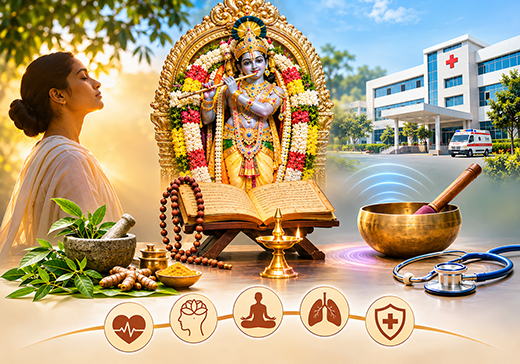
Modern healthcare is expensive due to rapid medical inflation, high corporate hospital mark-ups, and the high cost of advanced technology. Healthcare costs rise much faster than general economic inflation. In India, medical inflation runs at roughly 12% to 15% annually. Private hospital treatment in India is often 5 to 7.6 times more expensive than government or public facilities. Historically, healthcare inflation in India has been much higher than Consumer Price Inflation (CPI), it has been in the range of 12% to 14% as, compared to CPI. Hence quality healthcare becomes costlier for households. Unlike government hospitals that are subsidised, private hospitals pass all costs directly to patients. Additionally, major hospital chains often standardize pricing across cities, which leads to higher baseline treatment costs even in non-metro regions. As private healthcare expands, it sets a “market price” benchmark that pushes overall medical inflation upward.
A major but less visible driver of medical inflation in India is the increasing role of health insurance in hospital payments. Earlier, most patients paid out-of-pocket and were highly cost-sensitive. Today, a large portion of hospital bills is covered by insurance providers. This shift has changed pricing behaviour in healthcare. Hospitals often adjust pricing based on insurance coverage.
Even traditional healthcare systems like Ayurveda has become expensive, apart from the slow recovery process. But, Ayurveda has a branch of treatment called Daivavyapashraya Chikitsa or divine therapy, which uses religious chanting of sacred mantras and traditional prayers as a complementary practice to soothe the mind and support resilience, rather than as a cure for physical pathology. Chanting is a unique Hindu practice that involves the rhythmic repetition of a sacred sound, word, phrase, or verse, usually a Sanskrit mantra, done to calm the mind, focus devotion, and connect with the divine. The word mantra comes from the Sanskrit roots man (to think) and tra (to free or protect), meaning a tool that frees the mind from stress, clutter, and illusion.
Scientific studies on mantra meditation and chanting therapy show it can help reduce stress, lower blood pressure, slow the heart rate, and foster emotional balance
How deeply sound can touch the mind, body, and spirit? Ancient Hindu traditions and beliefs recognized sound as a bridge to inner balance and expanded awareness. Today, sound healing, chanting, and meditation are being rediscovered as powerful tools for stress relief, emotional release, and deep relaxation, which in turn can ameliorate to a certain extent, grave illnesses and diseases.
Sound healing is an ancient wellness practice that promotes healing, relaxation, and self-compassion. This is also referred to as vibrational medicine, a non-invasive treatment that employs sound vibrations to induce relaxation. Most people who live in cities are fully exposed to the hustle and bustle and will not find peaceful areas in their surroundings. The cases of disturbed mind and depression are increasing daily in number. Sound is the first thing our brain notices, as a result, our entire mood is determined by what our ears hear. Sound healing therefore is fundamentally important for the human body.
Studies on mantra meditation and sound therapy show it can help reduce stress, lower blood pressure, slow the heart rate, and foster emotional balance. Mantras supposedly attract Divine energy to us. The Mahamrityunjay Mantra is chanted for long life, avoiding sudden death and to give physical and mental peace. Research on the benefits of sound therapy is inconclusive but growing. Experts continue to gather scientific evidence supporting the benefits of binaural beats, sound baths and vibro-acoustic therapy. Sound therapy uses auditory frequencies, rhythms, and physical vibrations to promote relaxation, reduce stress, and support mental and physical well-being.
Sound has an ancient kinship with meditation and healing. The Tibetan or Himalayan singing bowl, quartz bowls, and bells to guide the listener. These practices highlight themes of how the experience of sound manifests not only through hearing but through tactile physical vibrations and frequencies.
In this context, the Narayaneeyam, composed by Melpathur Narayana Bhattathiri in 1586 CE, is a 1,034-verse devotional masterpiece in Sanskrit dedicated to Guruvayurappan (Lord Krishna). He contracted severe rheumatism and partial paralysis/arthritis after taking on the disease of his guru, Achyuta Pisharadi, out of compassion. Despite suffering the ailment, he composed 1,036 Sanskrit verses across 100 cantos (dashakams) summarizing the Bhagavata Purana, starting with the fish incarnation (Matsyavatara). Upon finishing the 100th canto and receiving a vision of Lord Guruvayoorappan, his physical affliction completely vanished. Hence the resolute belief of devotees that reciting the Narayaneeyam daily, causes relief and cure from severe diseases and ailments.
The text features powerful verses such as Dasakam 100, Shloka 10, which prays for the Lord’s feet to reside in the devotee’s heart and grant supreme bliss, and verses celebrating the work as the essence extracted from the Bhagavata Purana.
Some of the popular Themes & Verses by Dasakam are:
Dasakam 8, Verse 13: chanted for all health afflictions, and overcoming addictions.
Dasakam 13: Chanted for wealth, long life, and fame.
Dasakam 16: Chanted for longevity and the destruction of committed sins.
Dasakam 18: Chanted for victory and blessings of children.
Dasakam 27: Chanted for the fulfilment of all sincere wishes.
Dasakam 28: Lakshmi Swayamvaram: Chanted to remove marital discord.
Dasakam 79: Rukmini Swayamvaram – chanted to remove hurdles in matrimony.
Dasakam 82: chanted for victory in examinations, and to overcome trials and tribulations.
Dasakam 87: Details the endearing friendship between Krishna and Sudama (Kuchela), recited to invite grace, stability, and remove material hardships.
 Dr. G. Shreekumar Menon, IRS (Rtd), Ph.D. (Narcotics)
Former Director General of National Academy of Customs Indirect Taxes and Narcotics & Multi-Disciplinary School Of Economic Intelligence India; Fellow, James Martin Centre For Non Proliferation Studies, USA; Fellow, Centre for International Trade & Security, University of Georgia, USA; Public Administration, Maxwell School of Public Administration, Syracuse University, U.S.A.; AOTS Scholar, Japan. He can be contacted at shreemenon48@gmail.com
 Write Comment
 E-Mail To a Friend
 Facebook
 Twitter
 Print
- Narayaneeyam and Healthcare Missions
- DKRA: Five Decades of Championing Scientific Temper
- Is Drug addiction a chronic brain disease?
- Engineering colleges should explore new horizons
- 1980s AI photo trend goes viral, cyber experts warn users against sharing original photos
- AI readiness in Universities in India
- Why narcotics are part of every terror payload?
- Bombay’s Parsi Opium Dons
- In-Land Group Celebrates 40 Years of Excellence with Grand Anniversary Event in Mangaluru
- Solving India’s Education Crisis
- Rejuvenating The Priestly Class In Sanatana Dharma
- Durandhar’s exploration of hallucinatory drugs
- Race towards a Drug Free Nation
- Kashmir Bhavan in Bengaluru: A must visit place
- "MAI and I" Book of Angelic Emotions
- Draupadi Murmu - The New ’President of India’
- Anthony Ashram in the city grows a classic museum
- First College of Fisheries in India - A Golden Jubilarian
- Flushing Meadows - A Vintage Mansion
- The Colonel’s Bequest
- A Mangalorean PM and his RBI Governor Brother: The Extraordinary story of the Benegal Brothers
- There is no higher religion than Truth: Theosophical Society
- L’affaire - Ashu & Yiju of Mangalore
- Mangalore in Kowloon
- 1568 to 2018 AD: 450 years of Christianity in Mangaluru
- Vice President elect Naidu moves on from nadir to zenith, the phenomenal journey
- Embracing the Outdoors: How Heated Jackets Are Revolutionizing Cold Weather Activities
- Efficient and Sustainable Packaging Solutions with FIBCs
- The Hybrid Kilt Revolution | Where Tradition Gets Trendy
- Affordable Elegance | Embrace Style on a Budget with Cheap Kilts
- Unleashing Style and Functionality | Exploring Tactical Kilts
- Mangalore’s Heroic Lady marks 105th Birthday
- Santa the Christmas spirit
- Geriatric care: Mangalore strikes a fine balance
- The Don Who Made Two Empires to Clash
- CHITRAPUR SARASWATS - A Great Kanara Community
- Our new President Ram Nath Kovind’s significant journey to Rashtrapathi Bhavan
- Marriages made in heaven, big fat weddings made in India
- Eid insight - The giver of glad tidings


- Local Search
- Classifieds
- CITY INFORMATION
- TRAVEL
- TOURIST INFORMATION
- HEALTH CARE
- MISCELLANEOUS

© 2024 All rights reserved. MangaloreToday