




AI readiness in Universities in India
AI readiness in Universities in India
Mangalore Today News Network
By Dr. G. Shreekumar Menon
Mangaluru, August 13, 2026: AI is transforming the social, economic, and industrial landscape of all countries. Hence, Indian universities need to rapidly integrate artificial intelligence into curricula, research, and administration. Government leaders, global partners, and local institutions should be preparing for AI readiness, to shape future-ready higher education.
Existing AI systems are often made with foreign cultures and values embedded in their code, and because of this, AI will never work seamlessly within the Indian context. The vast amounts of data generated, monetization and control are invariably in the hands of foreign companies. This creates a “digital colonization” which is a major threat to the nation’s security. Increasingly, AI sovereignty is becoming a contentious issue necessitating calls for a strategy to protect the nation’s technological growth and security.
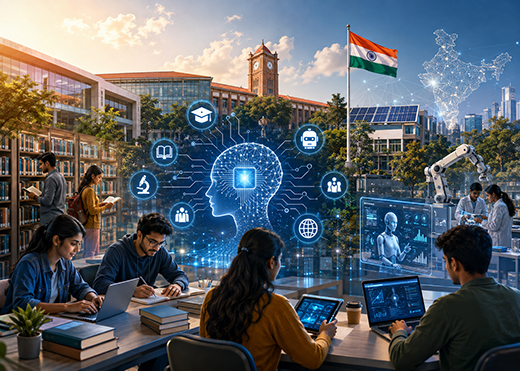
A skilled human workforce is essential for AI technologies to advance. AI literacy should be taught from primary and secondary institutions all the way up to universities to prepare the future generations for an AI-enriched world. Inclusive vocational training, gender gap-targeted initiatives, and public-private collaborations will help bridge the gap. Universities should transform into AI research hubs, which can educate skilled personnel, incubate start-ups, and help industries through cooperative innovation.
There are several challenges that are limiting the uptake of AI in many academic institutions, including, limited access to resources, limited exposure to AI tools by faculty, missing experts in AI and a rejection of the technology by some faculty. Due to increased overreliance on tools such as ChatGPT by students, there is a need to rethink teaching and assessment methods.
Artificial Intelligence (AI) is no longer a futuristic concept—it’s already shaping how we teach, learn, and manage education.
AI-powered platforms now make it possible to tailor education to individual student needs. AI can track progress, highlight gaps, and recommend content—something nearly impossible for lecturers to do manually. AI is already helping many universities to automate admissions, grading, and student support through tools like chatbots, giving staff more time to focus on academic excellence.
AI is also unlocking new opportunities for research. Whether it’s predictive modelling in agriculture, data-driven insights in healthcare, or climate-smart innovations, AI is enabling discoveries at a pace we’ve never seen before.
AI tools—such as intelligent tutors, voice assistants, and real-time translation—are making education more inclusive for students with disabilities and those from diverse linguistic backgrounds. This is especially critical in a country as diverse as India. AI is not about replacing educators—it’s about enhancing their ability to deliver quality and inclusive education. If adopted thoughtfully, AI can help universities prepare graduates who are globally competitive and locally impactful.
Of course, challenges remain: limited infrastructure, funding constraints, and ethical concerns around data privacy and bias. Without proper policies and governance, the digital divide could widen instead of narrow. In USA, Zohaib & Loupias (2025) found that students widely use AI for research assistance, writing assignments, and exam preparation and while students report high satisfaction levels, concerns about plagiarism and data privacy are prevalent emphasizing the need for clear guidelines and responsible usage policies to mitigate associated risks. In United Kingdom, The Guardian (2025) found that AI usage among students rose from 66% in 2024 to 92% in 2025 and students use AI to explain concepts, summarize articles, and suggest research ideas but concerns over academic misconduct and unreliable results persist, highlighting the need for universities to train staff on AI’s capabilities and collaborate on best practices. In China Cao, Fan, & Yang, (2024) found that ethical issues include the weakening of teacher-student relationships, privacy concerns, and academic misconduct due to improper human-computer interaction.
A common predicament facing global concern is that many students have started using ChatGPT to explore concepts faster, which supports learning although without proper guidance, it may not reflect actual student ability unless monitored. The adoption of AI has helped students struggling with academic writing bridge gaps in language and structure but has also introduced ethical concerns of whether we are grading students or AI-generated work? Therefore, we need to rethink how we assess learning outcomes to ensure fairness. AI can stimulate critical thinking if integrated into teaching for example, comparing AI responses with class discussions helps learners identify gaps and biases. However, without training, many students just copy-paste academic performance may go up, but cognitive development might suffer. We’re at a crossroads since AI supports flipped classrooms and independent study, which is great but we’ve also had cases where students submit assignments with AI-generated citations that don’t exist and although there’s a learning curve, we must guide students on responsible use.
There is urgent need for academic institutions to rethink assessment strategies, integrate digital literacy and responsible AI usage into the curriculum, and reinforce critical thinking through guided instruction to ensure AI becomes a tool for learning rather than a shortcut to success. The Kerala government has integrated Artificial Intelligence (AI) and robotics into the public school curriculum through updated ICT textbooks starting from Class 7, launched AI-driven free entrance exam coaching for higher secondary students, and established specialized ARISE labs for hands-on learning. The Artificial Intelligence-integrated ’Key to Entrance’ special training program launched by the Kerala Infrastructure and Technology for Education (KITE) will assist eight lakh students across Science, Commerce, and Humanities streams to excel in various competitive examinations.
In neighbouring Tamilnadu government introduced artificial intelligence (AI) and coding into government schools through the TN SPARK (Tamil Nadu School Programme for AI, Robotics and Knowledge of Online Tools) initiative. The program establishes a multi-tier framework for Classes 6 to 12, utilizing existing hi-tech labs to teach students digital literacy, programming, and generative AI tools.
Similarly, the Government of Andhra Pradesh has introduced artificial intelligence (AI) and prompt-based learning into state government schools. The phased rollout integrates AI tools, digital design platforms, and upcoming AI tutoring systems to build tech-ready classrooms for students.

AI Robot Teacher ‘Iris’ at a Govt School in Kundapur
The Karnataka government has rolled out major artificial intelligence initiatives in education, introducing AI as a vocational subject for Classes 9 and 10 in over 1,600 government high schools, planning curriculum integration starting from Class 6, deploying a personalized AI digital tutor for 1.2 million students, and announcing India’s first government-led AI university.
The Uttar Pradesh government has introduced a mandatory "AI for All" foundational course for over 2 lakh students in Classes 9 through 12 across 1,200 government secondary schools under Project Praveen. The initiative aims to build digital literacy, problem-solving, and future-ready job skills in alignment with the National Education Policy.
India is rolling out artificial intelligence education starting from Class 3 for the 2026–27 academic year, aligned with the National Education Policy (NEP) 2020. The nationwide framework introduces computational thinking, data literacy, and problem-solving to millions of students across both public and private schools.
India is navigating a massive educational landscape of over 250 million students. Here, the true transformation is not about replacing human contact but using technology to support overloaded teachers and provide resources to students who lack them. The Central Board of Secondary Education (CBSE) and NCERT have introduced structured AI skill modules starting as early as Class VI. This early exposure ensures that the next generation does not just view technology as a consumer product, but understands how computational thinking works. Higher technical education boards have similarly integrated machine learning fundamentals across all IT-related courses to keep up with industry demands.
The government’s nationwide digital infrastructure, DIKSHA, is integrating smart capabilities to serve millions of users. Features like voice-activated keyword searches within educational videos make it incredibly easy for students to find specific lesson topics instantly. This large-scale deployment proves that the impact of AI on education is expanding past private tech applications to become a core part of public education.
References:
1. Zohaib H. S. and Loupias H. H., (2025) Analyzing Chatgpt Integration in Higher Education: Usage Trends, Student Insights, And Ethical Considerations.
2. Cao, Y., Fan, J., & Yang, Q. (2024). ChatGPT in Education: Ethical Predicaments of Generative AI. Transactions on Social Science, Education and Humanities Research.
 Dr. G. Shreekumar Menon, IRS (Rtd), Ph.D. (Narcotics)
Former Director General of National Academy of Customs Indirect Taxes and Narcotics & Multi-Disciplinary School Of Economic Intelligence India; Fellow, James Martin Centre For Non Proliferation Studies, USA; Fellow, Centre for International Trade & Security, University of Georgia, USA; Public Administration, Maxwell School of Public Administration, Syracuse University, U.S.A.; AOTS Scholar, Japan. He can be contacted at shreemenon48@gmail.com
 Write Comment
 E-Mail To a Friend
 Facebook
 Twitter
  Print
Print - Engineering colleges should explore new horizons
- 1980s AI photo trend goes viral, cyber experts warn users against sharing original photos
- AI readiness in Universities in India
- Why narcotics are part of every terror payload?
- Bombay’s Parsi Opium Dons
- In-Land Group Celebrates 40 Years of Excellence with Grand Anniversary Event in Mangaluru
- Solving India’s Education Crisis
- Rejuvenating The Priestly Class In Sanatana Dharma
- Durandhar’s exploration of hallucinatory drugs
- Race towards a Drug Free Nation
- A Breathalyser for Drugs
- Budget 2026: High Stakes, Global Headwinds and Big Domestic Bets
- India’s Court Backlogs Keep Drug Lords On The Streets
- Kashmir Bhavan in Bengaluru: A must visit place
- "MAI and I" Book of Angelic Emotions
- Draupadi Murmu - The New ’President of India’
- Anthony Ashram in the city grows a classic museum
- First College of Fisheries in India - A Golden Jubilarian
- Flushing Meadows - A Vintage Mansion
- The Colonel’s Bequest
- A Mangalorean PM and his RBI Governor Brother: The Extraordinary story of the Benegal Brothers
- There is no higher religion than Truth: Theosophical Society
- L’affaire - Ashu & Yiju of Mangalore
- Mangalore in Kowloon
- 1568 to 2018 AD: 450 years of Christianity in Mangaluru
- Vice President elect Naidu moves on from nadir to zenith, the phenomenal journey
- Embracing the Outdoors: How Heated Jackets Are Revolutionizing Cold Weather Activities
- Efficient and Sustainable Packaging Solutions with FIBCs
- The Hybrid Kilt Revolution | Where Tradition Gets Trendy
- Affordable Elegance | Embrace Style on a Budget with Cheap Kilts
- Unleashing Style and Functionality | Exploring Tactical Kilts
- Mangalore’s Heroic Lady marks 105th Birthday
- Santa the Christmas spirit
- Geriatric care: Mangalore strikes a fine balance
- The Don Who Made Two Empires to Clash
- CHITRAPUR SARASWATS - A Great Kanara Community
- Our new President Ram Nath Kovind’s significant journey to Rashtrapathi Bhavan
- Marriages made in heaven, big fat weddings made in India
- Eid insight - The giver of glad tidings



- Local Search
- Classifieds
- CITY INFORMATION
- TRAVEL
- TOURIST INFORMATION
- HEALTH CARE
- MISCELLANEOUS

© 2024 All rights reserved. MangaloreToday