




Why narcotics are part of every terror payload?
Why narcotics are part of every terror payload?
Mangalore Today News Network
By Dr. G. Shreekumar Menon
Mangaluru, July 21, 2026: Narcotics are an integral part of terror payloads, across the world, primarily to fund operations, as the illegal drug trade generates massive, untraceable profits. Terrorism, whether in Kashmir, or in Manipur, requires a lot of money to buy weapons, pay operatives, and recruit members. Terror groups use the drug trade as a "cash cow" to generate tax free funds. Beyond money, narcotics serve a direct military purpose. Terror groups, especially in West Asia use strong stimulants (like Captagon) to keep fighters awake for days. These drugs also reduce fear, increase aggression, and block out physical pain. This makes the fighters temporarily fearless in battle. Smuggling illegal drugs is physically easy because they are small, lightweight, and highly valuable. Terrorists often share the same secret routes used by drug cartels to smuggle weapons and cash. They use the exact same paths to sneak both drugs and payloads across international borders.
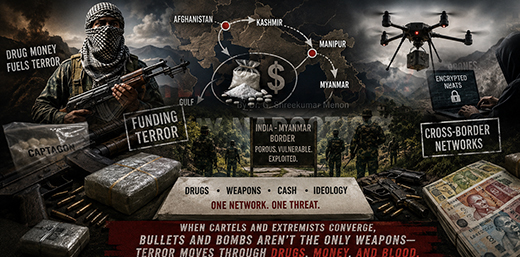
A major consequence of collaboration between drug trafficking and terrorism is regional destabilisation, as seen in Manipur. Terrorist organisations involved in the illicit drug trade often use the profits to finance their operations and expand their influence. This often results in increased violence and insecurity in the areas where they operate, disrupting local communities and undermining the efforts of the government that seek to ensure the security and well-being of the local population. The enormous capacity of drug traffickers to obtain institutional collaborators, especially NGO’s and foreign funded religious organizations in Kashmir and Manipur on the ground has been confirmed.
Months after the arrest of US drone expert Matthew Van Dyke from Manipur, another American US Special forces soldier has been detained in India under suspicious circumstances. Jordan Brown, an alleged spy and a resident of California, was arrested by the Sashastra Seema Bal (SSB) near the Sonauli India-Nepal border on July 11, 2026. The National Investigation Agency (NIA) alleges these foreigners are training Ethnic Armed Groups (EAGs) in Myanmar and Indian Insurgent Groups (IIGs) operating in the Northeast, directly impacting India’s national security. A handful of military experts smuggling knowledge and hardware can amplify local grievances into high-tech insurgency without massive footprints. Myanmar’s internal conflict has been turned into a testing ground for low-cost drone innovations used in asymmetric warfare, by foreigners. The easy availability of natural and synthetic narcotics in Myanmar and the North-east, is making foreign intervention very inexpensive. The tactics seen in the September 2024 attacks, drones dropping over 40 bombs on Meitei villages like Koutruk and Kadangband in Imphal West, killing civilians and injuring many others, mirror the expertise these foreign ex-military officers allegedly specialize in. Weaponized drones of the Kuki militants were deployed to drop explosives on civilian targets in Meitei-inhabited areas. On September 1, 2024, in Koutruk village, Imphal West district, Kuki militants had launched a multi-pronged assault from elevated hill positions, combining sniper fire with drones that hovered overhead and released multiple explosive payloads (described as grenade bombs, RPG heads, or improvised mortar devices).
The India-Myanmar border, rugged, forested, and ethnically linked, has long served as a conduit for arms, training, and narcotics. Retired Colonel RSN Singh, a former Research and Analysis Wing (RAW) officer, has described Manipur as a theatre in a broader "proxy war" where religion plays a pivotal role. The retired Colonel alleges that Christian militant elements, possibly supported by US Baptist networks and the CIA, are capitalizing on shared ethnic and faith ties between Myanmar’s Chin, Naga, and Karen communities and Northeast India’s Kuki and Naga groups. In May 2026, security forces had arrested four Myanmar nationals for their alleged involvement in drug trafficking in Manipur’s Churachandpur district.
India is also being used as a transit corridor to funnel deadly drugs into Gulf nations. In May 2026, the Narcotics Control Bureau (NCB) seized over 227 kilograms of Captagon, a powerful psychotropic stimulant widely abused across the Middle East, in what marks the country’s first-ever interception of the substance. The anti-drug body announced the breakthrough achieved under Operation RAGEPILL, revealing that an international syndicate had been systematically exploiting India as a transit corridor to funnel the powerful drug into Gulf nations. The operation, which unfolded across two states over four days, resulted in the arrest of a Syrian national, who had been illegally overstaying in India for over a year after his tourist visa lapsed. His questioning led investigators further. Four days later, on May 14 2026, NCB teams descended on a Container Facilitation Station in Mundra, Gujarat, and searched a shipping container that had arrived from Syria, declared as carrying sheep wool. Concealed within the cargo were three bags holding 196.2 kilograms of Captagon powder, the single largest haul of the operation. This consignment, too, was bound for Saudi Arabia and neighbouring Gulf countries, where the drug has become a major public health and law enforcement crisis.
Captagon, which primarily contains Fenethylline and amphetamine, is classified as a psychotropic substance under the Narcotic Drugs and Psychotropic Substances (NDPS) Act. An exotic stimulant, it gained global notoriety when the Syrian conflict broke out in 2011, where it was reportedly used by combatants to suppress fear and fatigue - earning it the sobriquet "Jihadi Drug". It is also widely abused as a sex drug across the Gulf region.
In July 2026, Punjab Police successfully busted a cross-border arms, narcotics and fake Indian currency notes (FICN) supply network with the arrest of three people following a probe into the killing of a cashier at a pharmacy in June 2026. During the operation conducted in the Tarn Taran and Amritsar districts of Punjab, police recovered 3.028 kg of the narcotic drug ICE (Methamphetamine), fake currency notes having a face value of Rs 8 lakh, two sophisticated pistols and magazines. The investigations have brought to light a deeply entrenched, multi-layered criminal pipeline. Handlers in Pakistan exploit Punjab’s geographic proximity to the Pakistan border to drop contraband drugs and weapons via low-flying drones. Once the payload hits the ground, a tightly controlled local network takes over. Operating via end-to-end encrypted messaging applications to dodge intelligence agencies, foreign operatives coordinate with local terror networks.
The Global Security Observers, opine “When cartels and extremists converge, bullets and bombs aren’t the only weapons—terror moves through drugs, money, and blood."
 Dr. G. Shreekumar Menon, IRS (Rtd), Ph.D. (Narcotics)
Former Director General of National Academy of Customs Indirect Taxes and Narcotics & Multi-Disciplinary School Of Economic Intelligence India; Fellow, James Martin Centre For Non Proliferation Studies, USA; Fellow, Centre for International Trade & Security, University of Georgia, USA; Public Administration, Maxwell School of Public Administration, Syracuse University, U.S.A.; AOTS Scholar, Japan. He can be contacted at shreemenon48@gmail.com
 Write Comment
 E-Mail To a Friend
 Facebook
 Twitter
  Print
Print - Is Drug addiction a chronic brain disease?
- Engineering colleges should explore new horizons
- 1980s AI photo trend goes viral, cyber experts warn users against sharing original photos
- AI readiness in Universities in India
- Why narcotics are part of every terror payload?
- Bombay’s Parsi Opium Dons
- In-Land Group Celebrates 40 Years of Excellence with Grand Anniversary Event in Mangaluru
- Solving India’s Education Crisis
- Rejuvenating The Priestly Class In Sanatana Dharma
- Durandhar’s exploration of hallucinatory drugs
- Race towards a Drug Free Nation
- A Breathalyser for Drugs
- Budget 2026: High Stakes, Global Headwinds and Big Domestic Bets
- Kashmir Bhavan in Bengaluru: A must visit place
- "MAI and I" Book of Angelic Emotions
- Draupadi Murmu - The New ’President of India’
- Anthony Ashram in the city grows a classic museum
- First College of Fisheries in India - A Golden Jubilarian
- Flushing Meadows - A Vintage Mansion
- The Colonel’s Bequest
- A Mangalorean PM and his RBI Governor Brother: The Extraordinary story of the Benegal Brothers
- There is no higher religion than Truth: Theosophical Society
- L’affaire - Ashu & Yiju of Mangalore
- Mangalore in Kowloon
- 1568 to 2018 AD: 450 years of Christianity in Mangaluru
- Vice President elect Naidu moves on from nadir to zenith, the phenomenal journey
- Embracing the Outdoors: How Heated Jackets Are Revolutionizing Cold Weather Activities
- Efficient and Sustainable Packaging Solutions with FIBCs
- The Hybrid Kilt Revolution | Where Tradition Gets Trendy
- Affordable Elegance | Embrace Style on a Budget with Cheap Kilts
- Unleashing Style and Functionality | Exploring Tactical Kilts
- Mangalore’s Heroic Lady marks 105th Birthday
- Santa the Christmas spirit
- Geriatric care: Mangalore strikes a fine balance
- The Don Who Made Two Empires to Clash
- CHITRAPUR SARASWATS - A Great Kanara Community
- Our new President Ram Nath Kovind’s significant journey to Rashtrapathi Bhavan
- Marriages made in heaven, big fat weddings made in India
- Eid insight - The giver of glad tidings


- Local Search
- Classifieds
- CITY INFORMATION
- TRAVEL
- TOURIST INFORMATION
- HEALTH CARE
- MISCELLANEOUS

© 2024 All rights reserved. MangaloreToday