




Controversy Erupts in Mangaluru Over ‘Nema’ Ritual Performance by ’Christian’ Man
Controversy Erupts in Mangaluru Over ‘Nema’ Ritual Performance by ’Christian’ Man
Mangalore Today News Network
Mangaluru, March 15, 2026: A controversy has erupted in coastal Karnataka after allegations surfaced that a person from the Christian community performed a ritual dance during a Nema ceremony, allegedly violating long-standing customs associated with Daivaradhane in Tulunadu.
Daivaradhane, or spirit worship, is considered an integral part of the cultural and religious identity of Tulunadu. Although rituals such as Nema and Kola involve the participation of around 16 communities, tradition dictates that the ritual performers known as Daiva Nartakas must belong only to the Pambada, Parava and Nalike communities.
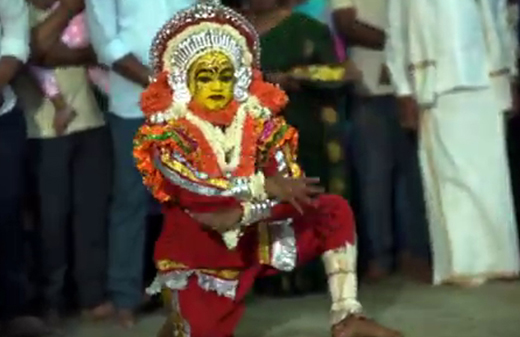
The controversy relates to a recent Nema held at a Daivasthana in Bolur, Mangaluru, where it is alleged that a person from the Christian community performed the ritual dance for a Banta Daiva. The temple’s administrative committee had entrusted the responsibility of conducting this year’s ritual to Ganesh Pambada of Chipparu Bayar in Kasaragod.
However, objections were raised after it emerged that the ritual was performed by the son of the late Ganesh Pambada of Padavinangady, who was born to his Christian wife.
Members of the Pambada community follow a matrilineal system. According to the traditional Aliyakattu practice, a person’s community identity is determined through the mother. Hence, despite being the biological son of the late Ganesh Pambada, the performer is considered to belong to the Christian community, leading to claims that the established customs were violated.
Researcher Dr Rathi, who belongs to the Pambada community and has raised objections to the incident, alleged that she was insulted for questioning the matter. She said she came to know about the issue only later and claimed that the concerned person should not be allowed to perform such rituals in future.
Dr Rathi has also demanded that the person should seek forgiveness before the deity for the alleged violation and warned that she would pursue a legal battle until the issue reaches a logical conclusion.
The incident has triggered debate in the region, as the performance of Daiva Nartana is regarded as a deeply sacred ritual carrying significant religious responsibility. Observers say it remains to be seen how the controversy will unfold in the coming days.
 Write Comment
 E-Mail
 Facebook
 Twitter
  Print
Print - Mysuru Dasara 2026: 50 art forms, 57 tableaux, military forces steal the show
- Man held for AI video depicting blast at Vidhana Soudha
- Mysuru Dasara 2026: Lakhs witness Jamboo Savari as elephant Prashantha carries the golden howdah
- SBI flags suspected dark web exposure of 3,897 customer records, launches probe
- Mysuru Dasara reaches finale with Jamboo Savari on Vijayadashami
- Delhi Police arrests four, including two women, in Tiger Shroff car Firing case
- Devaraj Urs academy confers honorary doctorate on Siddaramaiah
- Trump says India-US trade deal is ‘pretty close’, signals different kind of agreement
- Mohan Bhagwat: ’Call for regime change will not work in India’
- CJP leaders Ashutosh Ranka, Saurav Das’ judicial custody extended by two days
- An advocate shot dead by tenants in Bengaluru over rent dispute
- A man from Kalaburagi detained on ’terror link’ suspicion
- I will definitely contest; I will start now: Raghupathi Bhat fumes with anger
- Udupi: Human skull and skeletal remains found in Ananth Nagar, police launch probe
- Mangaluru: Sea of devotees witnesses grand Kudroli Dasara shobhayatra
- Neliyadi: PU student dies as car rams into parked gas tanker
- Moodbidri: Mother and son die of electric shock
- Mangaluru man loses Rs 1.78 lakh after downloading fake TV app
- Mangaluru: Muslim Yakshagana artist Arshiya Khan shines as Goddess Sri Devi, celebrates religious harmony
- KSRTC extends Dasara special tour packages in Mangaluru, Udupi till Oct 25
- Mangaluru Dasara procession: Traffic diversions from 4 pm on October 21
- Ullal: Two youths killed as pickup rams scooter in Boliyar; driver arrested for murder
- Belthangady: 21-year-old youth drowns while swimming in river
- A mobile dental van of the Department of Public Health Dentistry, ABSMIDS inaugurated
- Gold medalists in Asian Games, Poovamma, Arshiya Khan honoured
- Vittal Police Seize Two Tipper Lorries Transporting Sand Illegally
- Mangaluru Student Goes Missing; Ullal Police Register Case
- APD Foundation Joins WHO Civil Society Commission
- Daiva’s prediction comes true: Janardhan Reddy walks free from jail
- Skills and Competencies Take Center Stage at MSN Dialogue Series
- Court remands Maoist Lakshmi to six-day police custody
- Sandhya Shenoy honored with Society for Materials Chemistry Medal-2024
- White Cornus Apartment in Mangaluru
- City girl wins first place in state-level spell bee competition
- Alleged ‘Love Jihad’ Case in Mangaluru: Woman left home voluntarily, says police
- Girl fatally struck by reckless two-wheeler near Belman
- New residential complex for the judges inaugurated in Mangaluru
- Absconding accused nabbed after 8 years
- Truck with cylinders turns turtle in Beltangady
- Bhoota Kola artist dies of cardiac arrest


- Local Search
- Classifieds
- CITY INFORMATION
- TRAVEL
- TOURIST INFORMATION
- HEALTH CARE
- MISCELLANEOUS

© 2024 All rights reserved. MangaloreToday