




Indian students rethink ‘American dream’ as US college applications fall 15%
Indian students rethink ‘American dream’ as US college applications fall 15%
Mangalore Today News Network
New Delhi, Aug 25, 2026: The number of Indian students applying to US colleges fell 15 per cent in 2025-26 from the previous academic year, as tighter immigration policies and uncertainty over visa rules dampened interest among international applicants, according to a report by the Common App.
The non-profit organisation, which represents more than 1,100 institutions, said undergraduate applications for the 2026-27 academic year increased overall. However, international applications received through March 1 declined 10 per cent, marking the steepest fall recorded so far. Applications from India, the largest source of international students in the US, dropped 15 per cent during the period.
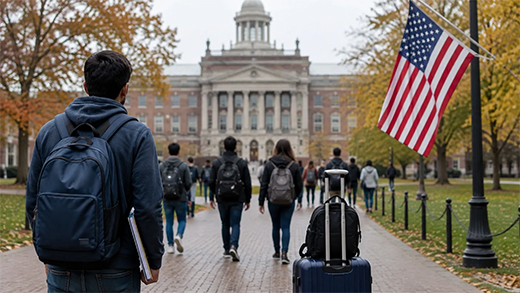
More than 3.63 lakh Indian students enrolled in US institutions across various programmes during the 2024-25 academic year, making India the largest contributor to the country’s international student population.
The decline comes amid growing uncertainty over US immigration and visa policies. International students contributed an estimated USD 41.77 billion to the US economy in Fall 2025-26, but that contribution is projected to decline to USD 38.37 billion in 2026-27.
A separate report by NAFSA: Association of International Educators and research firm JB International estimated that stricter visa policies and uncertainty could lead to up to 1.1 lakh fewer international student enrolments at US colleges and universities in Fall 2026.
The report estimated international student enrolment at 11.69 lakh in Fall 2025-26, compared with a projected 10.57 lakh this year.
The US government has also introduced measures affecting foreign students and workers. In July, it announced plans to replace the traditional "duration of status" system for student and visitor visas with a four-year limit, broadly corresponding to the length of a typical undergraduate course.
The administration is also considering a USD 100,000 fee for foreign students seeking to use the Optional Practical Training (OPT) programme after graduation. OPT allows international students on US student visas to work for up to 12 months, or up to 24 months in certain cases, and can provide a pathway to employer-sponsored H-1B visas.
H-1B Applications Face Proposed USD 103,265 Fee
Uncertainty also surrounds the H-1B visa route, which many international graduates rely on to continue working in the US after completing their studies.
The Department of Homeland Security has proposed an additional USD 103,265 charge for H-1B applications covered by the annual quota. The proposal would also apply to applications eligible for the master’s degree exemption, while cap-exempt filings would remain unaffected.
 Write Comment
 E-Mail To a Friend
 Facebook
 Twitter
  Print
Print - Indian national among two killed in attack on Saudi Arabia’s Dammam airport, two injured
- Thumbay puts Camel Science Centre stage, honours 12 leaders in animal health
- Around 500 Umrah pilgrims from coastal Karnataka stranded in Saudi Arabia amid flight disruptions
- US teen arrested for plotting mass shooting at Hindu temple in Illinois
- Two Indian seafarers missing, nine rescued after drone attack on tanker at Sohar Anchorage
- UAE, India and China leading participants at Sharjah’s Xposure Awards 2026-27
- GMU ranked No. 1 globally for International Outlook in THE World University Rankings 2027
- Hindu temple vandalised with bricks in US, devotees were present inside
- Delhi Police detain several protesters during ‘people against SIR’ march
- Will never support CJP, their agenda different: Annamalai clarifies amid row
- Hubballi woman dies after Kite Manja cuts her throat while riding scooty
- Establishing facts: India on Houthis’ claim Saudi Arabia targeted yacht carrying 14 Indians
- Asian Para Games: India’s gold medal tally rises to 25 as Harvinder, Nitesh and Sandeep Shine
- Bengaluru: Man arrested for murdering wife, dumping body in stormwater drain
- 16 dead, 65 injured as 7.0-magnitude earthquake hits China’s Tibet
- Mysuru Dasara 2026: 50 art forms, 57 tableaux, military forces steal the show
- Man held for AI video depicting blast at Vidhana Soudha
- Mysuru Dasara 2026: Lakhs witness Jamboo Savari as elephant Prashantha carries the golden howdah
- SBI flags suspected dark web exposure of 3,897 customer records, launches probe
- Mysuru Dasara reaches finale with Jamboo Savari on Vijayadashami
- Bantwal: Warrant accused absconding for nearly five years arrested
- Mangaluru: 1,500 Kg of fish expected to be sold at Pilikula Matsyotsava on October 25
- Udupi: Man arrested for extortion racket linked to gangster Hemanth Poojari
- Mangaluru Sharada Mahotsava concludes with grand procession
- Udupi: Bus driver’s quick thinking averts major accident after falling ill mid-journey
- Karnataka High Court: Breakup after consensual relationship not cheating over marriage promise
- Rain with thunderstorm lashes Udupi, Dakshina Kannada; more showers likely for two days
- Brahmavar: 62-year-old cyclist killed after lorry hits him on NH 66
- Karnataka hospitals must disclose medicine purchase prices, MRP on bills from November 1: Khader
- I will definitely contest; I will start now: Raghupathi Bhat fumes with anger
- Udupi: Human skull and skeletal remains found in Ananth Nagar, police launch probe
- Mangaluru: Sea of devotees witnesses grand Kudroli Dasara shobhayatra
- Neliyadi: PU student dies as car rams into parked gas tanker


- Local Search
- Classifieds
- CITY INFORMATION
- TRAVEL
- TOURIST INFORMATION
- HEALTH CARE
- MISCELLANEOUS

© 2024 All rights reserved. MangaloreToday