




Democracy Thrives on Dissent, Not Blind Loyalty: Deepa Bhasthi
Democracy Thrives on Dissent, Not Blind Loyalty: Deepa Bhasthi
Mangalore Today News Network
Mangaluru, June 10, 2026: Booker Prize-winning writer and translator Deepa Bhasthi said that loving a country and supporting a government are not the same, stressing that democracy can survive only when citizens are free to question authority and express dissent.
Delivering the annual P.P. Gomathi Memorial Oration on the theme “Thinking as Dissent: Some Thoughts on Language and the World” on Tuesday, Bhasthi said a government is never synonymous with a nation and that the right to dissent through writing, speeches and other forms of expression is fundamental to democracy. “When dissent is suppressed, it can no longer be called democracy,” she said.
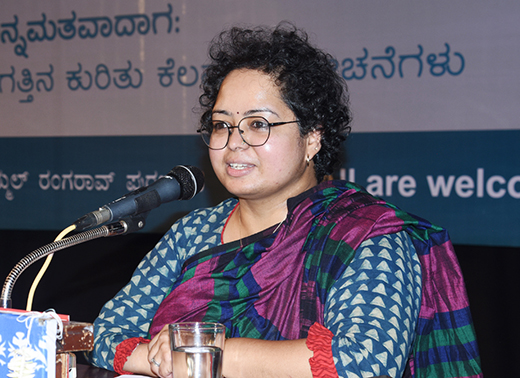
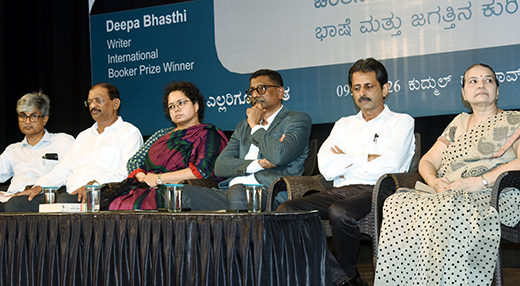
The programme was jointly organised by the P.P. Gomathi Memorial Education Trust, Mangalore University, Dakshina Kannada District Kannada Sahitya Parishat and the Dakshina Kannada Working Journalists’ Association.
Highlighting the cultural significance of language, Bhasthi said language carries a community’s art, architecture, ancestry and stories, describing Kannada as an emotion rather than merely a language.
She cautioned against the misuse of hate by those in power and said love remained a stronger force for social cohesion. Emphasising Karnataka’s linguistic diversity, she noted that the state is home to several vibrant languages, including Tulu, Beary, Kodava, Malayalam and Dakhani.
Bhasthi praised multilingualism as one of the greatest strengths of Karnataka and India, arguing that monolingualism is a colonial construct and that attempts to impose a single language on diverse populations should be resisted.
Responding to a question on Hindi imposition, she said there was no opposition to Hindi as a language but objected to its use as a tool to divide people. Similarly, she said the problem lay not with religions such as Hinduism or Islam but with radical forces that distort them.
She also challenged the notion of a “proper” English, calling for greater recognition of Indian English on par with Irish and Caribbean English. On the possibility of translating the Manusmriti, Bhasthi said she would consider it only if the opportunity and interest aligned.
Speaking about her translation of Hridaya Deepa, she said extensive research enabled her to approach the work beyond religious boundaries, adding that patriarchy affects all communities and that the stories carry universal themes.
Bhasthi expressed strong reservations about the use of artificial intelligence in creative fields. While acknowledging its value in medicine and scientific research, she said AI-generated books, paintings and artworks undermine human creativity. Urging students to critically evaluate online content, she encouraged them to read more poetry, e-books and audiobooks.
 Write Comment
 E-Mail
 Facebook
 Twitter
  Print
Print - Kolkata NEET protest violence: Two more held, police reconstruct crime scene
- Varanasi teacher brands hot knife on five-year-old’s private parts for urinating in pants, booked
- Honour your promise: CJP demands release of detained NEET-UG student protesters
- CJP effect: Dharmendra Pradhan’s exit fuels E20 Janta Party’s anti-ethanol campaign
- Will finalise cabinet expansion this week: Karnataka CM Shivakumar
- Centre introduces anti-paper leak bill in Lok Sabha amid oppn sloganeering
- ’He spoke, then shot’: Indian-origin woman, 26, killed in targeted attack in Canada
- My dream remains incomplete: 19-year-old NEET aspirant dies by suicide in Maharashtra
- Bihar cop, seen on camera firing at protesting students with AK-47, suspended
- ‘Felt great beating Pakistan’: Boxer Jadumani Singh dedicates victory to Kargil heroes
- Karnataka’s major reservoirs record second-lowest water storage in 6 years
- Nandan Nilekani to Head Task Force on Exam Reforms, Announces PM Modi
- Kasargod: Retired crime branch SI found hanging at residence
- Selection process for Dakshina Kannada Congress President to begin Tuesday: Harish Kumar
- Mangaluru: APMC secretary accused of sexual harassment; women’s team confronts official
- Mangaluru: Major tragedy averted as bus carrying 35 passengers crashes into barrier at Sooralpadi
- INTACH launches Album of the Porches, book documenting Mangalorean Catholic heritage homes
- Counterfeit currency case: Police seize printer, chemicals during search of accused’s house
- Mangaluru: Historic T-55 battle tank unveiled at Kadri War memorial on Kargil Vijay Diwas
- Bantwal: Elderly doctor assaulted, gold chain snatched; two-wheeler also stolen
- CISF, Mangaluru Airport Return Purse with $10,000 and Valuables to Dubai Passenger
- Retired Librarian Found Dead in Netravathi River in Bantwal
- GRP Seeks Help to Identify Unidentified Man Found Dead on Matsyagandha Express
- Beltangady Ambulance Driver Named Accused in ₹5.5 Crore MDMA Case, Absconding
- Dakshina Kannada Considers Taluk-Wise Rain Holidays to Minimise Academic Disruption
- Vittal Police Seize Two Tipper Lorries Transporting Sand Illegally
- Mangaluru Student Goes Missing; Ullal Police Register Case
- APD Foundation Joins WHO Civil Society Commission
- Daiva’s prediction comes true: Janardhan Reddy walks free from jail
- Skills and Competencies Take Center Stage at MSN Dialogue Series
- Court remands Maoist Lakshmi to six-day police custody
- Sandhya Shenoy honored with Society for Materials Chemistry Medal-2024
- White Cornus Apartment in Mangaluru
- City girl wins first place in state-level spell bee competition
- Alleged ‘Love Jihad’ Case in Mangaluru: Woman left home voluntarily, says police
- Girl fatally struck by reckless two-wheeler near Belman
- New residential complex for the judges inaugurated in Mangaluru
- Absconding accused nabbed after 8 years
- Truck with cylinders turns turtle in Beltangady
- Bhoota Kola artist dies of cardiac arrest



- Local Search
- Classifieds
- CITY INFORMATION
- TRAVEL
- TOURIST INFORMATION
- HEALTH CARE
- MISCELLANEOUS

© 2024 All rights reserved. MangaloreToday