




SC Senior advocate Sanjay Hegde calls for recognition of ‘Vaishnava Jana To’ as national prayer
SC Senior advocate Sanjay Hegde calls for recognition of ‘Vaishnava Jana To’ as national prayer
Mangalore Today News Network
Mangaluru, Oct 4, 2026: On the occasion of Gandhi Jayanti, senior Supreme Court advocate Sanjay Hegde has urged the Government of India to recognise ‘Vaishnava Jana To’ as the country’s national prayer, alongside the national anthem ‘Jana Gana Mana’ and ‘Vande Mataram’, which enjoys national song status.
Hegde was speaking at a B.V. Kakkilaya Memorial Lecture organised by Bengaluru-based Hosatu magazine, the M.S. Krishnan Memorial Trust, Mangaluru Samadarshi Vedike and the Department of Political Science, Mangalore University, at Ravindra Kala Bhavan, University College, Hampankatta.
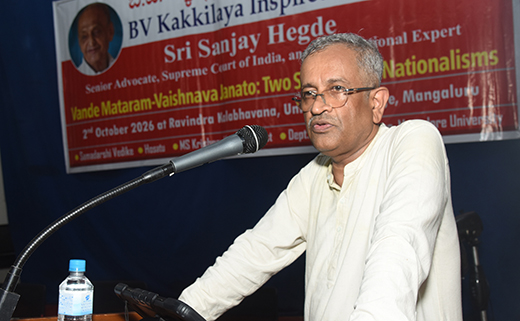
Speaking on ‘Vande Mataram–Vaishnava Jana To: Two Journeys, Two Songs of Nationalism’, Hegde said he was making the proposal in his capacity as a lawyer.
He suggested that the approach adopted in 1950 towards ‘Vande Mataram’ could be followed for ‘Vaishnava Jana To’. There should be no compulsion, punishment or requirement to stand while the prayer is sung, he said, adding that it should simply receive official recognition. Those who wish to sing it at national events should be free to do so, while schoolchildren could be taught its meaning in different languages.
Comparing the lyrics of ‘Vaishnava Jana To’ with the principles enshrined in the Constitution, Hegde said the song reflects values such as fraternity, freedom of expression, equality, secularism, respect for women, scientific temper, humanity and the right to question.
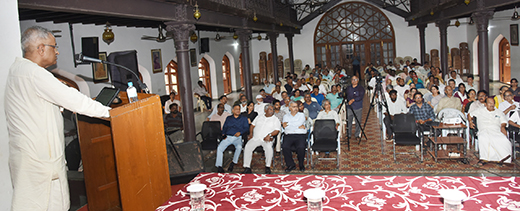
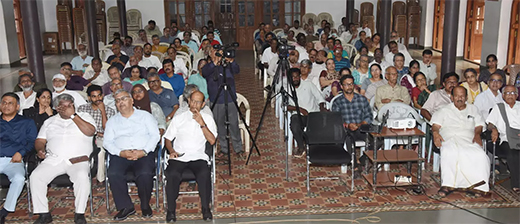
He argued that a compulsory song was a contradiction and that a compulsory prayer amounted to an affront to religious freedom.
Responding to possible objections that ‘Vaishnava Jana To’ is a Vaishnavite song containing references to Lord Rama, Hegde said the song had been sung for more than a century by Christians, Sikhs, Muslims and people with no religious faith without such objections becoming a barrier.
Hegde traced the origins of the song to 15th-century Gujarat poet-saint Narsinh Mehta, who was reportedly ostracised by his own community for composing the famous verse describing a true devotee as one who understands the pain of others. Mahatma Gandhi later incorporated the song into his prayer meetings, alongside verses from the Quran and Christian hymns.
He contrasted the two national songs, saying ‘Vande Mataram’ celebrates the motherland and calls upon citizens to bow before it, while ‘Vaishnava Jana To’ focuses on cultivating the moral character of citizens.
Hegde also traced the history of Bankim Chandra Chattopadhyay’s ‘Vande Mataram’ and explained how only two stanzas were adopted for national occasions.
He said that irrespective of the greatness of a poem or the sanctity of its history, a song that some citizens may find difficult to sing because of religious considerations cannot fully meet the requirements of a national anthem in a democratic country. He said ‘Jana Gana Mana’ meets that test by referring to different regions of India and encompassing the future of its people.
Referring to the Constituent Assembly’s decision on January 24, 1950, Hegde said then President-elect Rajendra Prasad had announced that ‘Jana Gana Mana’ would be the national anthem while ‘Vande Mataram’ would be accorded equal respect.
He argued that the decision was a compromise reflecting the diversity of the country and said reopening the issue repeatedly should not be seen as a sign of strength. He added that adopting two stanzas of ‘Vande Mataram’ for public purposes should not be viewed as disrespect to Bankim Chandra Chattopadhyay, noting that works are often adapted for specific public purposes.
Hegde also said the country needed to focus on unresolved challenges in education, healthcare, employment and other areas.
Dr Srinivasa Kakkilaya, speaking on the occasion, agreed with Hegde’s observation that Mangaluru, which was educationally and economically advanced around the time of Independence, had fallen behind in several respects. He said efforts should be made to restore the city’s earlier prominence.
Dr Siddhanagouda Patil of Hosatu, retired Mangalore University political science professor Jayaraj Amin, Dr Balasaraswathi and others were present.
Hegde further referred to the changing context of the lyrics of ‘Vande Mataram’, noting that the reference to “seven crore voices” originally represented the population of undivided Bengal. He said the song was later adapted to reflect a larger Indian identity and argued that, with the country now home to around 140 crore people, compulsion cannot be the means of creating a shared national identity.
“The Constitution does not require all of us to worship in the same manner. It requires all of us to remain equal citizens,” Hegde said.
He argued that instead of compelling everyone to sing a particular song, it would be better to encourage a spirit in which citizens voluntarily embrace the values represented by ‘Vaishnava Jana To’.
Hegde also spoke about his connection with the coastal region and expressed concern over what he described as changes in the social atmosphere of the region.
Recalling the Mangaluru he knew between the 1980s and 1985, he said the coastal region had produced personalities such as B.N. Rau, Kamaladevi Chattopadhyay, Shivaram Karanth and B.V. Kakkilaya and had historically been known for its economic and educational achievements.
He expressed concern that contemporary debates in the region increasingly revolve around issues such as banners, interfaith couples travelling together, pub-related incidents, attacks on churches and violence linked to cattle transportation. He said it was unfortunate that a society that once asked “What do you sell?” had increasingly reached a point where people ask “Whom do you worship?”
 Write Comment
 E-Mail
 Facebook
 Twitter
  Print
Print - Half-bald punishment for 82 students at Maharashtra ashram school sparks outrage
- Surat woman arrested for posting objectionable reel on Mahatma Gandhi
- Bengaluru citizens hug trees, seek public consultation on Hebbal short tunnel project
- Asian Games witnessed outstanding performances of our athletes: President Murmu
- Protests continue over inaction in alleged sexual harassment by Delhi Police, several detained
- India Finishes Fourth with 85 Medals at Aichi-Nagoya Asian Games
- Mass Disenfranchisement Would Negate Constitutional Order: SC Judge Ujjal Bhuyan
- Karnataka Seeks ₹7,500 Crore Drought Relief from Centre
- Asian Games: India retain hockey gold, beat Malaysia 5-1 to seal LA 2028 Olympic berth
- Form 7 row: EC to probe voter deletion claims, says CM Shivakumar
- Delhi Police registers 3 FIRs over anti-CEC protests; no accused named
- Asian Games 2026: India beat Pakistan by 19 runs to retain men’s cricket gold
- Mangaluru: 27-year-old man dies after car accident while travelling to Mantralaya
- DK Heavy rain: Lightning strike severely damages house in Bantwal, woman hospitalised
- Udupi: Belthangady man dies after falling from moving train
- Dasara 2026: KSRTC announces special package tours from Mangaluru from Oct 11
- 25-year-old youth dies in bike-lorry collision near Karkala bypass
- CFAL Robotics Team to Represent India at Battle of Robots 2026 in Moscow
- SC Senior advocate Sanjay Hegde calls for recognition of ‘Vaishnava Jana To’ as national prayer
- Worker Killed, Two Injured in Boiler explosion at Kumble Factory
- Six Employees Arrested for Diverting ₹12 Lakh in Passenger Fares at Manipal
- Strong Public Support Needed for High Court Bench in Mangaluru: Brijesh Chowta
- Puttur Students Enter Asian Golden Book of World Records for Sand Art Feat
- Khader Urges Centre to Bring All Life-Saving Drugs Under Price Control
- ‘Swachh Nadige’: Foot march from Sampaje to Mangaluru to promote waste management awareness
- Vittal Police Seize Two Tipper Lorries Transporting Sand Illegally
- Mangaluru Student Goes Missing; Ullal Police Register Case
- APD Foundation Joins WHO Civil Society Commission
- Daiva’s prediction comes true: Janardhan Reddy walks free from jail
- Skills and Competencies Take Center Stage at MSN Dialogue Series
- Court remands Maoist Lakshmi to six-day police custody
- Sandhya Shenoy honored with Society for Materials Chemistry Medal-2024
- White Cornus Apartment in Mangaluru
- City girl wins first place in state-level spell bee competition
- Alleged ‘Love Jihad’ Case in Mangaluru: Woman left home voluntarily, says police
- Girl fatally struck by reckless two-wheeler near Belman
- New residential complex for the judges inaugurated in Mangaluru
- Absconding accused nabbed after 8 years
- Truck with cylinders turns turtle in Beltangady
- Bhoota Kola artist dies of cardiac arrest



- Local Search
- Classifieds
- CITY INFORMATION
- TRAVEL
- TOURIST INFORMATION
- HEALTH CARE
- MISCELLANEOUS

© 2024 All rights reserved. MangaloreToday