
ECI orders Special Summary Revision of electoral rolls in Karnataka
Mangalore Today News Network
Bengaluru, Nov 17, 2026: The Election Commission of India (ECI) on Monday announced the schedule for the Special Summary Revision (SSR) of electoral rolls in Karnataka, with January 1, 2027, set as the qualifying date.
The exercise assumes significance following the recently concluded Special Intensive Revision (SIR), during which around 1.08 crore voters were deleted from the electoral rolls, drawing concerns from political parties and citizen rights groups.
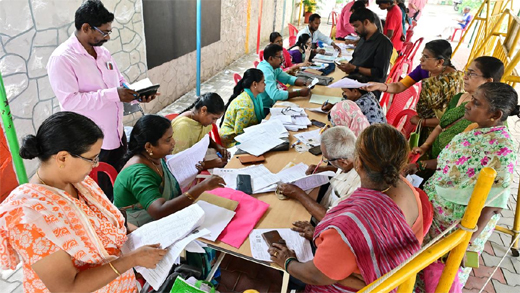
In a directive to the Chief Electoral Officer of Karnataka under Section 21 of the Representation of the People Act, 1950, the ECI said the revision aims to ensure that eligible voters, particularly those left out, young voters and first-time electors, are enrolled.
Besides citizens attaining 18 years of age on or before January 1, 2027, those becoming eligible on the subsequent qualifying dates of April 1, July 1 and October 1, 2027, can also submit advance applications during the revision process.
The commission has instructed Electoral Registration Officers (EROs) to ensure that no eligible voter is left out and no ineligible person is included in the electoral rolls.
Citizens can apply for inclusion through Form 6, deletion or objection through Form 7, and corrections or change of address through Form 8. Applications can be submitted online through the Voter Service Portal (voters.eci.gov.in) or the ECINET mobile application.
Strict safeguards against wrongful deletions
The ECI has introduced stringent verification measures to prevent wrongful deletions. Limits have been imposed on bulk Form 7 applications seeking removal of voters from the rolls.
EROs will personally verify cases where deletion requests exceed two per cent of the total electors at a polling station or where a single objector submits objections against more than five voters.
Booth Level Agents (BLAs) of recognised political parties can submit up to 10 forms per day to Booth Level Officers (BLOs). However, if a BLA submits more than 30 forms during the entire revision period, the ERO or Assistant ERO must conduct personal cross-verification.
Weekly lists of claims and objections will also be shared with recognised political parties and published online.
BLOs will collect updated standard photographs of electors. EROs have been instructed to remove duplicate entries, deceased voters and those who have permanently shifted, following due procedure under Form 7. All claims and objections received during continuous updation must be disposed of before the publication of the draft electoral roll.
Polling station rationalisation and accessibility
The commission has made 100 per cent physical verification of polling station locations mandatory before their rationalisation.
EROs have been directed to ensure that no polling station has more than 1,200 electors without prior approval from the ECI. Voters should not be required to travel more than two kilometres or cross natural barriers to reach their polling stations.
To improve accessibility in urban areas, authorities have been asked to conduct extensive surveys to identify locations for new polling stations on the ground floors of high-rise buildings, group housing societies, Resident Welfare Association (RWA) colonies and urban slum clusters.
The latitude and longitude of all polling stations will also be recorded and updated on the ECINET platform. The commission has further directed that families residing at the same address should not be split across different polling stations, with all members assigned to the same booth.
Special camps for vulnerable groups
State authorities have been instructed to establish help desks and organise special enrolment camps for marginalised and hard-to-reach communities, including migrant workers, homeless people residing in night shelters, women, transgender persons, senior citizens and persons with disabilities.
Invoking Article 324 of the Constitution, the ECI has directed the Karnataka Chief Secretary to ensure that no posts of District Election Officers (DEOs), EROs or Assistant EROs remain vacant during the revision exercise.
The commission has also prohibited the transfer of officials associated with the SSR from December 1, when the draft electoral roll is scheduled to be published, until January 20, when the final roll will be released, without its prior approval.