
DKRA: Five Decades of Championing Scientific Temper
mangaloretoday.com
Mangaluru, November 05, 2026: Dakshina Kannada Rationalist Association (DKRA) formerly South Kanara Rationalist Association (SKRA) takes birth during the Emergency in 1976. Five decades of campaigns against superstition and the promotion of rational thinking, the association has played a significant role in Karnataka’s rationalist movement.
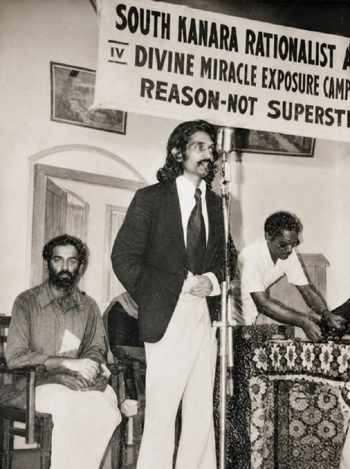
The year was 1976. India was in the grip of the Emergency imposed by Prime Minister Indira Gandhi, and the press was operating under stringent pre-censorship. Publications were forced to remove censored material without leaving blank spaces, making it difficult for journalists to publish anything critical of the government. Controversies surrounding godmen and their alleged supernatural powers, however, offered a relatively safe subject for public debate.
At the centre of this debate was Sathya Sai Baba of Puttaparthi, who claimed to materialise objects out of thin air. His claims were challenged by prominent rationalists Abraham T. Kovoor and H. Narasimhaiah, who sought to subject alleged miracles to scientific scrutiny.
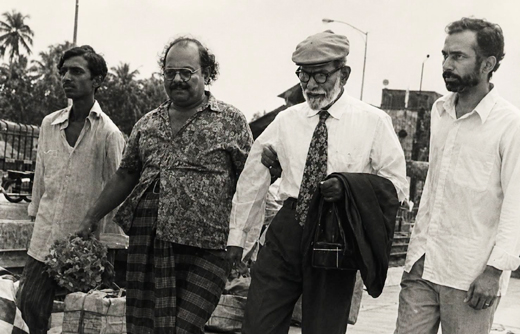
Kovoor, who was born in India but later settled in Sri Lanka, travelled across India conducting what he called Divine Miracle Exposure programmes. He offered a reward of Rs. 1 lakh to anyone who could demonstrate any of the alleged miracles listed in his challenge. His campaign provoked strong reactions from orthodox groups and devotees of various godmen.
It was against this backdrop that the South Kanara Rationalist Association (SKRA) took shape. After twenty-five years, it was registered with change in the name Dakshina Kannada Rationalist Association (DKRA). (South Kanara District was divided into Udupi and Dakshina Kannada Districts)
A newspaper controversy sparks a movement
The immediate trigger for the formation of the association was a newspaper article published in Manipal that criticised Kovoor and rationalists in general. Narendra Nayak, who was then completing his MSc at Kasturba Medical College, Manipal, was angered by the article.
Along with Kudpi Rajanikant Shenoy and his brother Rajendra, Nayak decided to write a rejoinder. Although the editor initially refused to publish it, the group persisted, and the response eventually appeared in the newspaper.
When the same writer subsequently described Kovoor as a fraud, the young rationalists challenged him to meet Kovoor in Mangaluru and expose him if his allegations were true. This challenge set the wheels in motion for Kovoor’s proposed visit to the region.
The group approached the Indian Rationalist Association (IRA) to arrange a programme in Mangaluru during Kovoor’s next tour of India. The response was that dates could be allotted to organisations, rather than individuals, subject to certain conditions.
The young enthusiasts therefore decided to form an organisation of their own. The South Kanara Rationalist Association was formally established on November 25, 1976.
A small group with a big mission
The association began with around 25 members. Five were above the age of 40, while the majority were twenty five or younger. Among the senior members were G.K. Nettar, B.R. Mallya, Raghuvir Kodial and Dinakar, along with Mr. Patil who served as registrar of the then Karnataka Regional Engineering College, now NITK.
The younger group included Kudpi Rajanikant Shenoy, Vinod Kamath, Manel Annappa Nayak, Prakash Shetty and Arunachalam Kumar, then a final-year MBBS student at Kasturba Medical College, Mangaluru. Three brothers from the Nayak family; Rajendra, Surendra and Narendra were also involved.
Students, bank employees and members of local friendship circles joined the initiative. The association was, by its founder’s recollection, an all-male organisation at that time.
Its early days were modest. Members communicated through postcards and held meetings at an open ground near the area now associated with the Karavali Utsava grounds. Yet, the group was united by a common objective: to encourage rational thinking and challenge claims that could not withstand scientific examination.
Early experiments in exposing alleged miracles
One of the association’s first public programmes was organised at the postgraduate centre of Mysore University at Konaje, then known as Mangalagangothri. The programme was arranged by Panditaradhya, a lecturer at the institution.
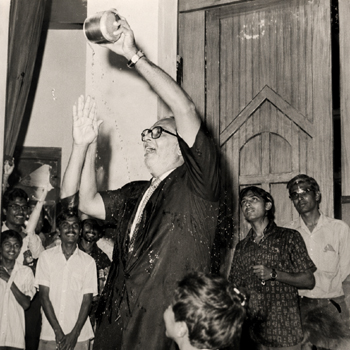
Narendra Nayak represented the association, speaking to students and staff about the importance of rational thought. He also attempted to demonstrate how the production of vibhuti, one of the best-known alleged miracles associated with Sathya Sai Baba, could be replicated through a trick involving a pouch and a tube.
The demonstration did not proceed entirely as planned. The mechanism reportedly became unusable after two attempts. The incident nevertheless became a memorable episode in the association’s early history.
The first attempt to communicate scientific explanations of alleged miracles had produced mixed results, but it marked the beginning of the group’s public outreach.
The ‘Premanand’ connection
The association’s activities initially remained limited and the death of Abraham T. Kovoor in September 1978 created a vacuum in the movement to expose alleged supernatural claims.
A new figure soon emerged to carry forward that work: Basava Premanand, who continued Kovoor’s efforts with considerable dedication.
The Dakshina Kannada Rationalist Association (DKRA) came into contact with Premanand through Prof. Shankar, a magician associated with the Maya Amateur Magicians troupe. Premanand and his brother Dayanand were invited to conduct programmes in the district.
The first programme was held in Udupi and was preceded by a procession through the streets. Participants demonstrated practices presented as extraordinary feats, including pulling a car using hooks passed through the skin of the back, placing burning camphor on the tongue and performing other dramatic acts.
The event took an unexpected turn when Premanand began his address with a provocative statement about the meaning of the sound “Aum”. A section of the crowd rushed towards the stage and attacked him, forcing him to stop speaking. The programme in Mangalore, organised by the Dakshina Kannada Rationalist Association, proceeded without a similar incident.
The controversy, however, continued after the programmes. A regional newspaper launched a campaign against the rationalists, prompting the association to clarify its position on atheism and other contentious issues. Some of the magicians who had participated in the demonstrations distanced themselves from the movement, insisting that they were entertainers without any ideological commitment.
The episode led to an important decision: the association would work with individuals and groups who clearly understood and supported its objectives.
Subsequent programmes featuring Premanand were organised in collaboration with Samudaya, a progressive cultural organisation. These events received a favourable response and helped popularise the rationalist movement in the region. Premanand was invited to the district on several occasions, strengthening the association’s experience and public presence.
From local initiative to a state-wide movement
A major opportunity for expansion came in 1987 with the launch of the Bharatiya Jana Vignana Jatha. promoting scientific temper by explaining and demystifying alleged miracles was among its activities. The initiative later became associated with the Bharatiya Gyana Vigyana Samithi.
Through these programmes, the Dakshina Kannada Rationalist Association gained wider recognition and emerged as one of Karnataka’s prominent rationalist organisations. Its growing network also brought it into collaboration with the Karnataka Rajya Vijnana Parishat, enabling activities to be organised through branches across the state.
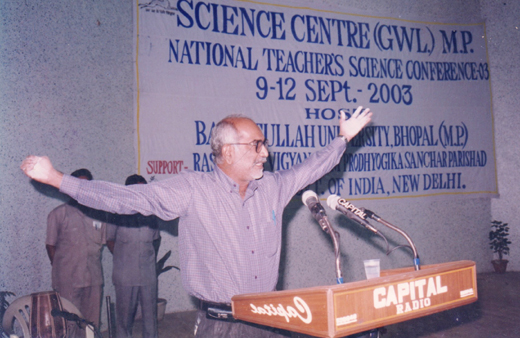
The association’s reach expanded further in 2004, when Narendra Nayak was unanimously elected president of the Federation of Indian Rationalist Associations (FIRA). The activities of the district organisation and the national federation became closely intertwined, with several campaigns receiving wider publicity through the national body.
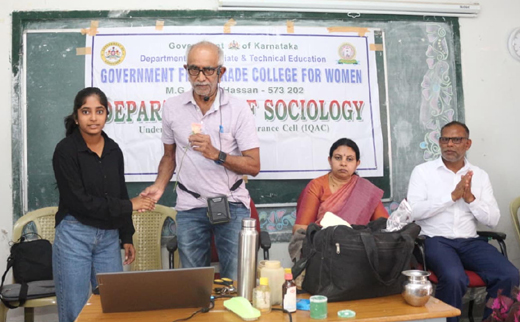
The work also extended beyond exposing alleged miracles. In 2011, the Aid Without Religion Trust was established to support deserving individuals and activities without involving religious considerations, superstition or unscientific beliefs.
Nayak was also recognised by the National Council for Science and Technology Communication (NCSTC) as a national-level master resource person. In this capacity, he trained science activists and teachers in the scientific explanation of alleged miracles. Thousands of activists from different parts of the country received training through these efforts.
Campaigns against superstition and exploitation
Over the decades, the association has taken up a wide range of campaigns against superstition, pseudoscience and misleading claims. Its activities have included challenging false advertisements, examining claims of blindfolded vision and questioning practices presented as supernatural phenomena.
It has also intervened in cases where religious beliefs or institutions were alleged to have been used to exploit followers. The association supported campaigns relating to allegations of exploitation at Dharmasthala and took up the cause of RTI activist Vinayak Baliga, who was murdered after questioning the accounts of the Venkataramana Temple and Kashi Math, according to the account of the movement.
The association has also supported and conducted inter-caste and inter-religious marriages, reflecting its commitment to social equality and individual choice.
Another significant initiative involved a project with the NCSTC to develop at least two activists in every district of the country who could scientifically examine and explain claims of miracles. The project was later discontinued after 2014.
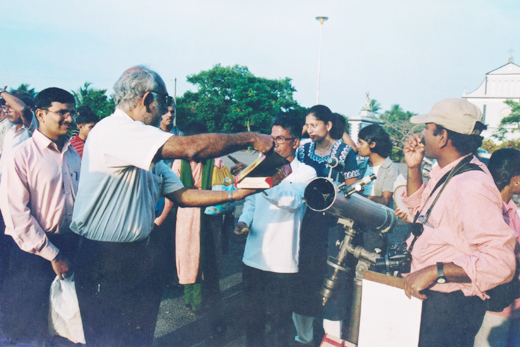
For the association, these initiatives represented a broader mission: to encourage people to question extraordinary claims, seek evidence and make decisions based on reason rather than fear or blind belief.
The risks of standing by one’s convictions
The work of rationalists has not been without danger. The murders of rationalist Narendra Dabholkar, Govind Pansare, M.M. Kalburgi and journalist Gauri Lankesh brought a new dimension to the challenges faced by those advocating scientific temper and questioning entrenched beliefs.
Narendra Nayak was placed under police protection from 2016 until 2023, according to his account. He also recalled attempts on his life from which he managed to escape.
These experiences underscored the risks associated with a movement that often challenges powerful social, religious and ideological interests. Despite the threats, the association continued its activities, determined to uphold its commitment to rational thought and scientific inquiry.
Remembering those who stood by the movement
As the association looks back on its journey, it also remembers the contributions of supporters who are no longer alive.
Devadas M., who accompanied Narendra Nayak on several journeys connected with the movement, died during the COVID-19 pandemic. Prasanna, an electrical engineer, was another committed supporter. Vittala Bhandary, who participated in the association’s activities along with his father, R.V. Bhandary, also died during the pandemic.
Their contributions form part of the larger story of the movement. Many others, both members and supporters from outside the organisation, have continued to lend their time, resources and encouragement over the years.
The association acknowledges that it would be difficult to compile a complete list of everyone who has contributed to its work.
Fifty years of questioning, learning and moving forward
As the Dakshina Kannada Rationalist Association completes 50 years in 2026, its journey reflects the evolution of a small group of young enthusiasts into an organisation with links to statewide and national rationalist initiatives.
What began in the charged atmosphere of the Emergency grew into a sustained effort to promote scientific temper, challenge superstition, question unsubstantiated claims and encourage social reform. Its history has included public demonstrations, educational programmes, collaborations with other organisations, social campaigns and the personal risks faced by some of its members.
The golden jubilee also presents an opportunity to renew the movement. The association believes that younger people must take the initiative forward with fresh ideas, energy and approaches suited to changing times.
A series of programmes is planned to commemorate the milestone. The inaugural meeting, scheduled for November 22, 2026, at the Karnataka Bank Employees Association Auditorium, will mark the beginning of the anniversary-year activities.
After five decades, the association’s central message remains relevant: scientific temper is not merely about exposing alleged miracles. It is about cultivating a habit of questioning, examining evidence, resisting exploitation and making reasoned choices.
The future will depend on how successfully the experience of the past is carried forward by a new generation committed